


Health Savings Account
Save for healthcare costs today and in the future.

Why Choose an HSA?
An HSA combines tax advantages with practical ways to save and pay for qualified healthcare expenses.
Tax-Deductible Contributions
Your contributions may be tax-deductible, up to annual IRS limits.
Tax-Free Employer Contributions
Employer contributions, if offered, are tax-free.
Tax-Free Qualified Withdrawals
Use HSA funds tax-free for a wide range of qualified medical expenses.
No “Use It or Lose It” Rule
Unused funds roll over year after year and can continue growing tax-free.
Keep Your HSA With You
Change jobs, cities, or financial institutions, and your HSA goes where you do.
More Freedom After 65
After age 65, you can use HSA funds for non-medical expenses without penalty.
HSA Eligibility
Your health coverage and tax status affect HSA eligibility. Use the table below as a quick guide.
-
Age 18 or older
Age 18 or older
-
Covered by a qualifying HDHP
Covered by a qualifying HDHP
-
Covered by Medicare
Covered by Medicare
-
Covered by a non-HDHP health plan
Covered by a non-HDHP health plan
-
Claimed as a dependent on someone else’s tax return
Claimed as a dependent on someone else’s tax return
Eligible Individual HSA
-
Age 18 or older
-
Covered by a qualifying HDHP
-
Covered by Medicare
-
Covered by a non-HDHP health plan
-
Claimed as a dependent on someone else’s tax return
Eligible Family HSA
-
Age 18 or older
-
Covered by a qualifying HDHP
-
Covered by Medicare
-
Covered by a non-HDHP health plan
-
Claimed as a dependent on someone else’s tax return
HSA Account Basics
$1 Minimum to Open
$300 Minimum to Earn Dividends
$5 Monthly Fee
Use Your HSA Visa® Debit Card
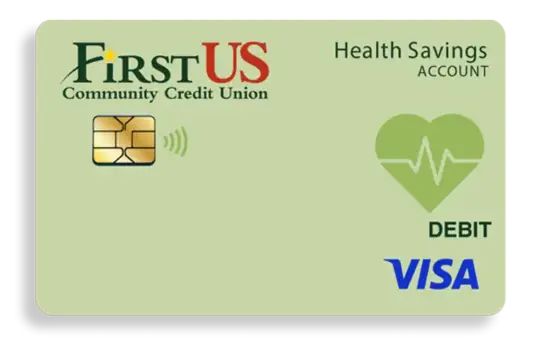
Pay for qualified medical expenses directly with your First U.S. HSA Visa® debit card.
- Use your chip-enabled, contactless card at doctors, pharmacies, dentists, and other providers
- Track transactions with eAlerts
- Keep receipts for HSA purchases and withdrawals
2026 Contribution Limits
Each year, the IRS publishes updated guidance on plan contributions and limits.
-
Individual
Individual
-
Family
Family
-
Contribution Limits
-
Individual
$4,400
-
Family
$8,750
-
55+ Catch-Up Contribution Limit
-
Individual
$1,000
-
Family
$1,000
-
Min. Annual Deductible
-
Individual
$1,700
-
Family
$3,400
-
Max. Out-of-Pocket Spending
-
Individual
$8,500
-
Family
$17,000
-
Want to save even more in 2027? The IRS has announced next year’s limits. Learn more
See our HSA rates.
|
APY* |
Rate |
Minimum Balance to Open |
Minimum Balance to Earn Dividends |
|---|---|---|---|
|
*APY = Annual Percentage Yield. Rate = Dividend Rate. |
|||
|
APY* 0.10% |
Rate 0.100% |
Minimum Balance to Open $1 |
Minimum Balance to Earn Dividends $300 |
Ready to open your HSA?
Disclosures
-
You must be covered under a qualified High Deductible Health Plan (HDHP) to open an HSA. Keep receipts for all HSA debit card purchases, as withdrawals must be for qualified medical expenses. Consult your tax advisor regarding specific tax situations.